Dr. Lora L. Yusi Commends FCPC’s Growth, Quality, and Global Vision During AppliedHE Xchange @ FCPC

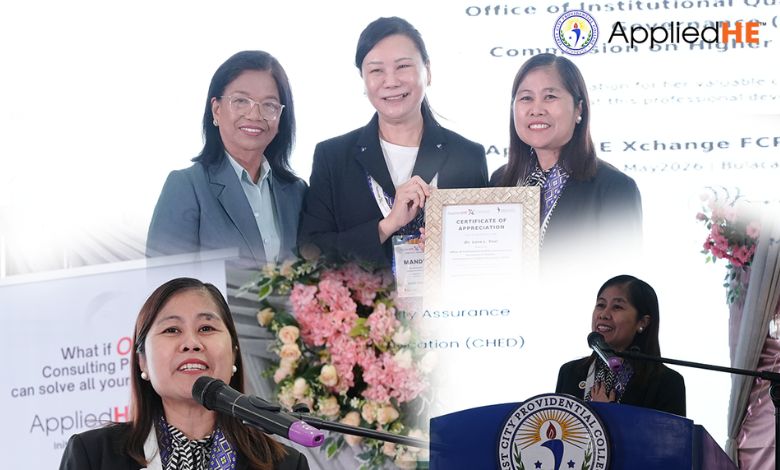
In her welcome address during the AppliedHE Xchange @ FCPC, Dr. Lora L. Yusi, Director IV of the Commission on Higher Education’s Office of Institutional Quality Assurance and Governance, praised First City Providential College for its remarkable transformation, commitment to quality assurance, and growing presence in the international higher education landscape.
Addressing FCPC President Dr. Estrella Simon, whom she fondly referred to as “Dr. Star,” Dr. Yusi commended her consistent leadership and vision that continue to drive the institution forward.
She highlighted FCPC’s successful debut in the World University Rankings for Innovation (WURI), emphasizing that despite being one of the smaller higher education institutions in the country, FCPC continues to prove that impact is not defined by size, but by quality and purpose.
“You may be small, but you have quality,” she emphasized, noting that quality assurance remains the key to institutional growth and recognition.
Dr. Yusi also reflected on FCPC’s journey from being a hesitant institution to becoming an autonomous college aspiring for university status. She recalled the institution’s early visits to CHED, where administrators openly sought guidance regarding autonomy and institutional development.
“It may be difficult, but if you have the best intentions and the will to transcend your limitations, things will happen favorably,” she shared, citing FCPC as an example of perseverance, humility, and continuous improvement.
She further emphasized the importance of partnerships in higher education, stressing that institutions cannot grow in isolation. According to her, collaboration with organizations such as PACUCOA and international partners plays a vital role in strengthening quality assurance and institutional development.
Dr. Yusi also underscored the changing definition of student readiness in today’s educational landscape. She explained that higher education institutions must go beyond academic performance and focus on developing adaptive, resilient, and ethically grounded graduates capable of navigating emerging technologies such as artificial intelligence.
“It’s not just about using a computer anymore. It’s about having the critical thinking to work with AI — knowing when to trust the data and when to apply human ethics,” she emphasized.
In addition, she highlighted the importance of cross-cultural empathy, global mindset formation, leadership, teamwork, resilience, and other soft skills that prepare students for real-world challenges beyond the classroom.
“We want to see institutions that prioritize the human element. We want classrooms that are laboratories for leadership, empathy, teamwork, and resilience,” she stated.
Her message served as a strong reminder that the future of higher education lies not only in academic excellence, but in forming agile, globally minded, and compassionate graduates prepared to thrive in an evolving world.