University of Auckland Strengthens Pacific Research Collaboration with University of Newcastle

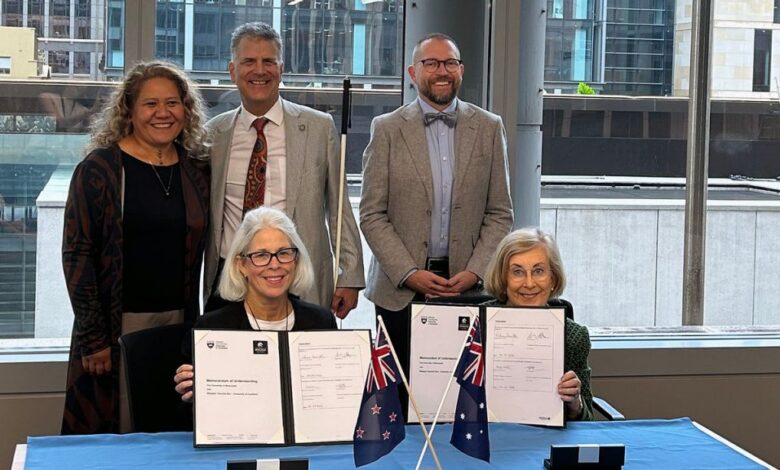
The University of Auckland and the University of Newcastle in Australia have entered into a strategic partnership aimed at enhancing research capacity in the Pacific region. A Memorandum of Understanding (MoU) was signed in Sydney on March 5, 2026, with the goal of fostering opportunities for Pacific scholars, students, and communities in both Aotearoa New Zealand and Australia.
Signing Ceremony
The signing ceremony included prominent figures such as Vice-Chancellor Professor Dawn Freshwater and Pro Vice-Chancellor Pacific Professor Jemaima Tiatia-Siau from the University of Auckland, as well as Chancellor of the University of Newcastle, the Hon Patricia Forsythe AM.
Focus of the Agreement
The agreement focuses on collaborative initiatives that incorporate Pacific knowledge and leadership. Specific elements of the partnership include researcher exchanges, the development of master’s and PhD programs centered on Pacific issues, co-supervision of research projects, collaboration on grants, and partnerships that respond to the needs of Pacific communities.
Support System for Pacific Scholars
Moreover, the MoU aims to establish a comprehensive support system for Pacific scholars, facilitating their progression from undergraduate to higher degree research (HDR) studies.
Importance of the Agreement
Professor Freshwater noted the importance of the agreement, indicating that building Pacific research capacity can lead to large-scale Pacific-led solutions for critical issues such as climate resilience and health equity.
Collaborative Efforts
The partnership outlines several collaborative efforts, including:
- Development of HDR pathways that involve shared supervision and jointly created research programs intended for Pacific scholars.
- Mobility programs designed to cultivate leadership skills for emerging Pacific academics.
- Joint research efforts that tackle priorities like health equity, sustainability, and cultural heritage, while respecting Indigenous data sovereignty principles.
- Creation of a Pacific Research Impact Hub to translate research findings into practical community applications.
Empowering Pacific Communities
Professor Tiatia-Siau emphasized that enhancing research capacity enables Pacific communities to formulate and lead initiatives through collaborative research efforts. He stated that Pacific communities possess the solutions, and the role of academic institutions is to support these communities with research capacity, resources, and respect.
Trans-Tasman Relationship Strengthening
The Acting Vice-Chancellor of the University of Newcastle, Professor Belinda Tynan, acknowledged the significance of the partnership in strengthening the trans-Tasman relationship between the two institutions. She noted that the MoU will reinforce both universities’ dedication to equitable collaboration in the region and promote initiatives that enhance Pacific research leadership.
Alignment with Pacific Strategy
This partnership is also aligned with the University of Newcastle’s inaugural Pacific strategy, which seeks to bolster trans-Tasman collaboration and improve support systems for Pacific involvement in research and education.
Addressing Climate and Social Challenges
The agreement underscores the urgent need to address the climate and social challenges faced by Pacific communities, advocating for responses that are led by these communities. It reflects a broader vision aimed at expanding research pathways and integrating Indigenous and local knowledge within academic frameworks.
Contributions to Research and Policy Development
The collaboration takes into account the significant Pacific populations residing in both Aotearoa New Zealand and Australia, highlighting the contributions of these communities to research and policy development.
Conclusion
In conclusion, the partnership between the University of Auckland and the University of Newcastle seeks to enhance academic efforts that amplify Pacific voices and leadership in addressing vital regional issues.
(Original source: University of Auckland)