

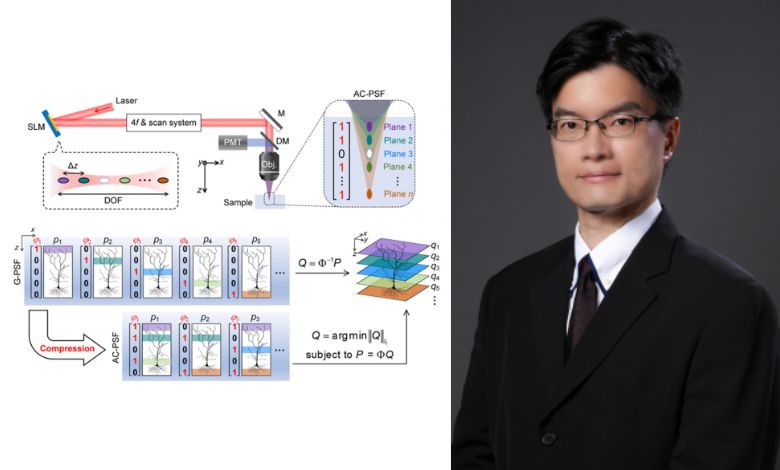
A research team from The University of Hong Kong Engineering has developed an innovative imaging technology called AIMED (Arbitrary Illumination Microscopy with Encoded Depth), introducing a new approach to overcoming speed limitations in three-dimensional multiphoton microscopy.
Led by Professor Kenneth K. Y. Wong and the OMEGA Laboratory, the research combines axial optical encoding with advanced computational image reconstruction to significantly accelerate 3D imaging while reducing light exposure and maintaining high image quality. Unlike traditional plane-by-plane scanning methods, AIMED simultaneously captures multiple depth layers in a single exposure and reconstructs detailed volumetric images using compressive sensing algorithms.
The technology demonstrated strong performance in experiments involving mouse brain imaging, successfully capturing fine neuronal structures such as dendrites and axons with reduced optical power. Researchers reported that AIMED maintained excellent image fidelity and achieved up to an eightfold increase in imaging speed in large-scale volumetric tasks.
One of AIMED’s major advantages is its compatibility with existing imaging systems, requiring minimal hardware modifications while improving efficiency and reducing phototoxicity risks for sensitive biological samples.
The research team believes the technology could support future advancements in neuroscience, biomedical imaging, and intelligent imaging systems. The findings were published in the journal Advanced Photonics.