AUB Remembers and Honors Professor Walid Khalidi, Esteemed Palestinian Historian

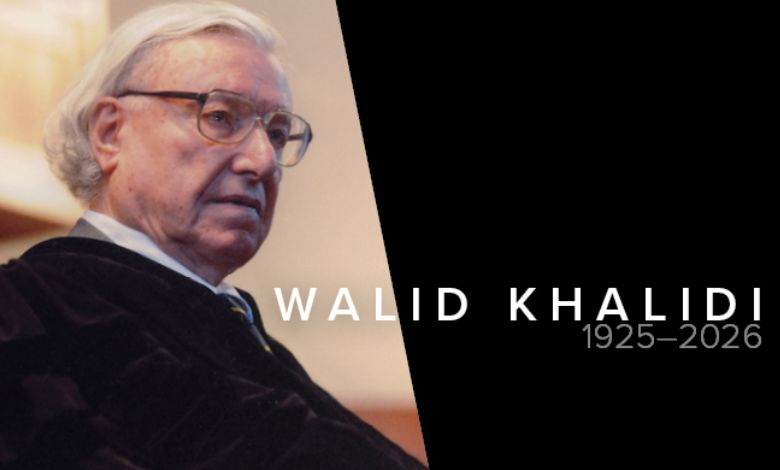
The American University of Beirut has announced the passing of Professor Walid Khalidi, a distinguished Palestinian historian and a long-serving member of its faculty. He was recognized for his substantial contributions to the study of modern Middle Eastern history and dedicated his career to the preservation of the collective memory of the Palestinian people.
Early Life and Education
Professor Khalidi was born in Jerusalem in 1925 and was part of a prominent family known for its jurists and political figures. Early in his career, he worked with the Arab Office, which was established by the Arab League to advocate for Palestine on the international stage. He obtained a bachelor’s degree from the University of London in 1945, followed by a master’s degree from the University of Oxford in 1951, where he also began teaching Islamic studies.
Academic Career at AUB
In 1957, Khalidi joined the Department of Political Studies and Public Administration at AUB, where he taught for 25 years and influenced numerous generations of students who later became prominent figures in various fields throughout the Arab world. His academic journey also featured fellowships and professorships at institutions such as Princeton University and Harvard University’s Center for International Affairs.
Scholarly Contributions
Khalidi’s scholarly work provided critical perspectives on the Palestinian experience and offered rigorous historical analyses of the Arab-Israeli conflict. His notable publications include Before Their Diaspora: A Photographic History of the Palestinians, 1876–1948 and All That Remains: The Palestinian Villages Occupied and Depopulated by Israel in 1948, both of which are essential to understanding Palestinian history.
Public Engagement and Legacy
Outside of academia, Khalidi remained active in public life, advising political leaders and participating in discussions on Lebanon’s political challenges. He co-founded the Institute for Palestine Studies in 1963, the first independent research institute of its kind in the Arab world, and held significant roles in diplomatic initiatives, including serving as an adviser during the Madrid Peace Conference in 1991.
Recognition and Impact
Throughout his career, Khalidi received numerous accolades for his contributions, including the Jerusalem Prize from the Palestinian National Authority and an honorary doctorate from AUB in 2010. His legacy is honored within the AUB community for the lasting impact he made on both academia and public discourse. The university has extended its condolences to his family, friends, and all those influenced by his work.
(Source: American University of Beirut)