3rd Shanghai Assembly on Cosmology and Structure Formation at SJTU: Advancing Astrophysical Research

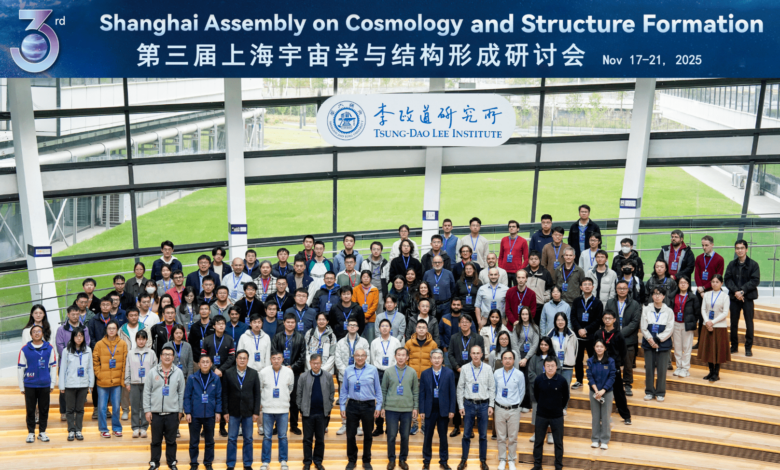
The 3rd Shanghai Assembly on Cosmology and Structure Formation was held from November 17 to 21, 2025, at the Tsung-Dao Lee Institute (TDLI) of Shanghai Jiao Tong University (SJTU). Co-organized by the Department of Astronomy and the Astronomy and Astrophysics Division at SJTU, the event received support from the State Key Laboratory of Dark Matter Physics.
Conference Overview
The conference focused on advanced topics in cosmology and structure formation, drawing over 130 participants from respected institutions worldwide. Attendees included representatives from Durham University (UK), Leiden University (Netherlands), and the University of Bologna (Italy), along with scholars from notable Chinese universities such as Tsinghua University and Peking University.
Event Highlights
The Assembly featured a series of invited talks, major presentations regarding international sky survey projects, and poster sessions. Discussions highlighted significant scientific areas including dark matter, dark energy, cosmic large-scale structures, and the processes of galaxy formation and evolution.
Keynote Address and Organization
Professor Yang Xiaohu, who serves as the Deputy Director of the TDLI, provided the opening address. Conference chairs included Associate Professors Zhai Zhongxu, Yu Yu, and Alessandro Sonnenfeld, while key conclusions were drawn by Professor Han Jiaxin, who has chaired previous assemblies.
Astrophysical Insights
The assembly examined the current landscape of astrophysics, with an emphasis on reconstructing the universe’s history through theoretical modeling, numerical simulations, and observational data. Innovations in “precision cosmology” were discussed, particularly the impact of new large telescopes and sky surveys on mapping the three-dimensional structure of the universe.
Theoretical and Observational Advances
Presentations covered theoretical advancements as Professor Carlos Frenk of Durham University addressed challenges related to the cold dark matter model. Various teams from institutions, including Leiden University and Kavli IPMU, shared developments in cosmological hydrodynamical simulations and the detection of cosmic filaments. The conference also highlighted innovative AI techniques in studying galaxies, underscoring the integration of theory, observation, and emerging technologies.
Current Challenges in Cosmology
On the observational side, representatives from major international collaborations reported advances in weak gravitational lensing, supernovae observations, and baryon acoustic oscillations. Additionally, the conference tackled ongoing issues in cosmology, including discrepancies in Hubble constant measurements and the amplitude of structure formation.
Local Contributions and Academic Commitment
Local contributions from SJTU faculty and students included research presentations on dark matter and galaxy formation, reinforcing the university’s commitment to academic excellence and innovation in research.
Conclusion and Future Prospects
Launched in 2019, the Shanghai Assembly has established itself as a significant platform for highlighting achievements in cosmology and promoting dialogue between emerging researchers and established experts. The successful hosting of the event has strengthened academic consensus and is anticipated to foster future exploration of cosmological frontiers through collaborative efforts.
(Source: Shanghai Jiao Tong University)