

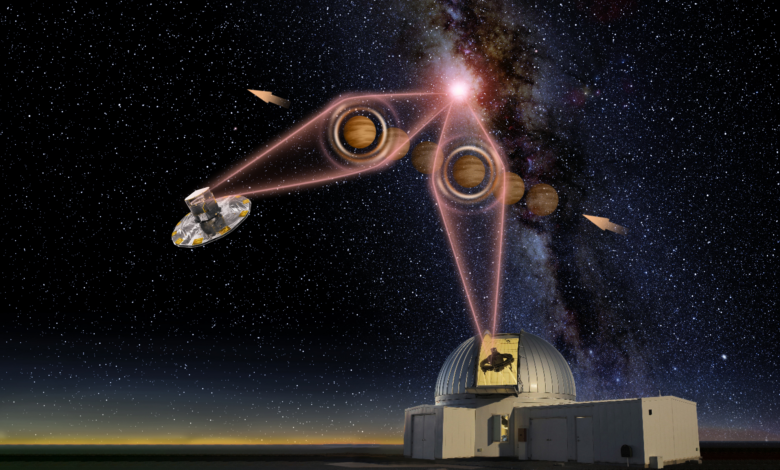
Astronomers have confirmed the mass measurement of a rogue planet candidate for the first time, marking a significant advancement in celestial studies. This achievement resulted from a collaboration between space and ground-based telescopes, enabling researchers to quantify the mass of a rogue planet, which is defined as a celestial body that does not orbit a host star.
Detection of Rogue Planets
Typically, rogue planets are detected through a phenomenon known as microlensing, where the gravitational field of the planet bends and magnifies the light of a background star during alignment. While this technique has previously identified numerous candidate rogue planets, it has often lacked definitive measurements regarding their characteristics.
First Accurate Mass Measurement
A recent study published in the journal Science, led by Dong Subo from Peking University, presents the first accurate mass measurement of a rogue planet candidate. The analysis determined that the planet possesses a mass roughly equivalent to one-fifth that of Jupiter, resembling the mass of Saturn. This finding provides clarity regarding the classification of the planet and contrasts sharply with the earlier uncertainties surrounding the masses of such celestial bodies.
Observations and Techniques Used
The observations leading to this discovery occurred on May 3, 2024, during a two-day microlensing event identified as KMT-2024-BLG-0792/OGLE-2024-BLG-0516. The event involved two surveys—the Korea Microlensing Telescope Network (KMTNet) and the Optical Gravitational Lensing Experiment (OGLE)—and coincided with measurements from the Gaia spacecraft, resulting in a unique convergence of data.
Researchers utilized the parallax effect, similar to how humans achieve depth perception, to ascertain the distance and mass of the rogue planet candidate. This technique has provided deeper insights than traditional methods, which generally produce only rough estimations.
The Implications of the Findings
The findings support theories suggesting the existence of billions or even trillions of rogue planets within the Milky Way, often ejected from their original planetary systems due to gravitational interactions.
This study signifies a key development in the understanding of rogue planets, indicating that these solitary celestial bodies are prevalent and measurable. Future research endeavors, such as NASA’s Nancy Grace Roman Space Telescope and China’s Space Station Survey Telescope, are expected to further investigate this phenomenon, potentially uncovering hundreds more rogue planets and enhancing the understanding of their origins and characteristics.
International Collaboration
The research collaboration includes contributors from various countries, including China, Korea, Poland, Israel, the United Kingdom, Switzerland, Sweden, Germany, the United States, and New Zealand.
For additional information, the original study is published in the journal Science.
Original source: Peking University News.