
Unseen Cosmic Explosion: The Hidden Gamma-Ray Burst with Unprecedented Afterglow

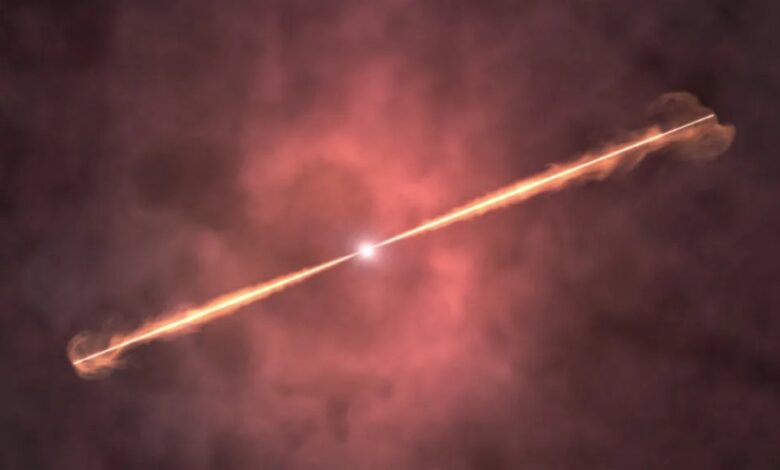
Researchers have identified what could be a significant example of a hidden cosmic explosion, unveiling a radio afterglow from a powerful gamma-ray burst that initially went undetected. This finding, which is set to be published in *The Astrophysical Journal*, marks an advancement in the understanding of these astronomical events.
Understanding Gamma-Ray Bursts
Gamma-ray bursts are brief, yet extremely potent jets of high-energy radiation generated by the collapse of massive stars into black holes. These bursts release an energy output comparable to that of the Sun over its entire lifetime in just a few seconds. Although these events emit radiation in all directions, only a small fraction directed towards Earth can be observed, leaving emissions away from our line of sight unnoticed. Consequently, astronomers typically observe the afterglow as it fades over time rather than the initial explosion.
The Challenge of Orphan Afterglows
The existence of “orphan afterglows,” or afterglows that occur without an accompanying high-energy flash, has been theorized for decades; however, locating them has presented considerable challenges. Astronomers are required to scan extensive areas of the sky for transient radio emissions, as these afterglows do not announce their presence with observable bursts.
Key Discovery with ASKAP
The crucial discovery was made using the Australian SKA Pathfinder (ASKAP), a system comprising 36 radio telescope antennas that scanned large sections of the sky for unexpected long-lived radio transients. An earlier wide-field survey revealed a previously unseen radio source designated ASKAP J005512-255834, which displayed a rapid increase in brightness before beginning to dim. This source produced energy at a rate comparable to that of billions of Suns, distinguishing it from typical radio transients that either evolve rapidly or show repeated flares.
Characteristics of ASKAP J005512-255834
Despite its strong radio signal, ASKAP J005512-255834 did not generate detectable emissions in visible light or X-rays, aligning with astronomers’ predictions regarding orphan afterglows. This suggests that the source may have originated from a cosmic explosion that was not directed toward Earth.
Location and Environment
Located approximately 1.7 billion light-years away from Earth, ASKAP J005512-255834 has been traced back to an irregularly shaped galaxy that is actively forming stars, a probable environment for extreme stellar occurrences such as supernovae or stellar disruptions. Its positioning within the galaxy deviates from the central nucleus, indicating that it may be located in a densely populated region of star clusters.
Exploring Alternative Explanations
Researchers considered various alternative explanations for ASKAP J005512-255834, including the scenario of a star being disrupted by an intermediate-mass black hole, which could account for the observed radio behavior. However, this hypothesis has yet to be definitively confirmed.
Future Implications
The identification of this orphan gamma-ray burst afterglow is recognized as an opportunity to further investigate transient events in the universe. By employing the methodologies used in this study, scientists aim to enhance their understanding of the gamma-ray burst population, including those that have eluded detection thus far.
(Source: University of Sydney)